Revisiting Context Organization in Omnifocus

Contexts seem to be a point of contention when it comes to any GTD system. How many should you have? What should they be? How many is too many? A quick look at the countless methods being discussed in the Omnifocus Forums show that there is no single right way for picking contexts, and when you consider the possibility of a task having multiple contexts (not currently possible in Omnifocus), it gets more complicated. The age old answer of “It depends” truly applies here. That being said, a few things stand out for me when I look at those long lists of contexts that people have.

Don’t try to do too much with Contexts

In its purest form, a context is a tool or location. II need to be at home in order to clean the shower in my bathroom, so “home” is a great example of a context. No matter how much I wish it were true, there’s simply no way I could get my shower cleaned while I’m at work. The problems tend to creep in when you start to factor in other things like energy levels, time available, or urgency.

On paper it makes sense to define these various lists to drill down to what you can work on at any given moment, but if you use something as powerful as Omnifocus, there are more options available to you for this than just contexts. There are due dates and flags to indicate urgency or importance and durations to indicate quick wins or when you’re looking for something to do during a set period of time. Prefixing tasks with a “mindset” such as “READ:” or “WATCH:” can also help you define your tasks by mode as well.

Don’t think to Granularly

When I first started implementing GTD, I thought I needed an incredibly complex list of contexts. I had geo-tagged sub-contexts for each of the stores I visited, contexts for every person I regularly talked to, and even contexts for every room in my house. Much like the trend towards fewer folders when managing email, I quickly learned that the cost of managing a lot of sub-contexts can be* far greater than the benefits especially if the contexts only contain a small handful of tasks.

*Notice I said can be. Sometimes granularity does help as is the case with my Grocery Store context discussed later.

Adding a prefix to a task can also really come in handy here. Instead of having a sub-context for a friend, consider putting their name before the task (e.g. Boss’s Name: Discuss Office Layout). You can still easily drill down to all tasks involving your boss by searching his or her name, but you won’t need to worry about a lengthy list of contexts. I do this with stores now as well.

Regularly Review and Adjust

In the paper planning world, reconfiguring your system is seen as “Planner Fail”. It’s frowned upon, probably because it takes so long to recopy everything. The beauty of software like Omnifocus is that there’s no need to recopy everything over if you need to make a change. Contexts and projects can be created, removed, or rearranged just as quickly as your life changes. While I’ve distilled my contexts lists down over the years, I still regularly consider making changes. In fact, I just got rid of two contexts today that were being used sparingly.

My Contexts

  • Do – Some tasks can truly be done anywhere
  • Campus – For work or graduate school related tasks that require me to be on campus
  • Home – For things that need to be done at home
    • Arriving – This is a geotagged context to alert me of anything I need to be reminded of when getting home (e.g. bring that item that’s been sitting in my trunk in with me)
  • People – Anything I need to discuss with a person at a later date.
  • Errands – All things I need to do when I’m out and about.
    • Shopping – Anything I need to buy.
      • Grocery Store – Anything I need to buy specifically at the grocery store.
        • Sub-contexts for each aisles – Subcontexts, in this case, allow me to keep my custom grocery perspective organized based on the layout of the store I shop at. For a more detailed explanation, I wrote about it here: Creating a Smart Grocery List in Omnifocus
  • Waiting – Any tasks that are part of active projects but are waiting on something or someone else before they can be completed.

Revisiting Project Organization in Omnifocus

A lot has changed in the 2 years since I last wrote about how I organize my projects in Omnifocus. I actually had to chuckle a bit when I looked at the projects I used to have. Things look so much simpler when you compare that list with my list of projects today. Now that I’ve been using Omnifocus consistently for over two years now, and one of the biggest takeaways I’ve learned is that how you organize your projects and contexts can make or break how well perspectives can work for you. I now pay close attention to how my projects are listed so that the most important ones show up first.

2016-04-14 screenshot-2

At the very top of my projects is my Daily Routines list. This is a single action list for all the little things I want to make sure I’m doing every day to keep my life on track. This includes things like checking my calendar, flagging tasks I want to accomplish for the day, and reviewing emails. It lives at the top of my projects and stays flagged so that it shows up front and center when I’m working from my perspectives.

The next section of my project lists is my Areas of Responsibility, which haven’t really changed that much. You’ll still find Work, School, and Personal as before. However, you’ll now also find an area called Home. Turns out being a homeowner is almost a full time job in itself, so it quickly earned its own section. Again, the areas, as with everything in my projects list, are listed in order of priority so that they show up in order of importance in my perspectives.

2016-04-14 screenshot-3

Each area of responsibility is organized in a similar way – each having its own single actions list for any miscellaneous tasks followed by single action lists for sub-areas of responsiblity. These are areas like personal development for work, finance under personal, and cleaning under home. After the sub-responsibilities, you’ll find sequential or parallel projects for any current projects I’m working on.

Following the areas of responsibilities, you’ll find a single actions list for my shopping list. I’ve written a couple fairly detailed posts on how I use Omnifocus in conjunction with my recipe manager, Paprika, and my Amazon Echo along with a custom perspective to manage grocery shopping, but this list also includes anything else I need/want to buy that isn’t tied to a particular project.

2016-04-14 screenshot-4

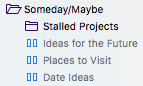
Next up is the Someday/Maybe folder. For those of you familiar with GTD, this is self explanatory. For those of you who aren’t, anything I might want to do or haven’t committed to doing currently lives here. This also includes a sub-folder containing any stalled projects (prefixed with their area of responsibility) so that they don’t clutter up my lists of active projects. Another thing you’ll find in this folder are various lists of things to do or check out and places visit. I’d been keeping these lists in various locations over the years but recently decided they were better stored here in Omnifocus where I could regularly review them.

Last but not least, you’ll find a folder for templates. There aren’t any real changes here. I use it to hold lists for things that happen over and over again but don’t repeat on a regular basis (e.g. hiring a new employee or packing for a trip).

Note: I used to keep separate Someday/Maybe and Templates folders inside of each area of responsibility. Not only did it make my list incredibly long, it was a pain to browse through on my phone too. I consolidated these into single folders and haven’t looked back.

On TextExpander’s Recent Announcement

Yesterday morning, Smile announced some pretty big changes to one of my favorite apps, TextExpander. Like many, the minute I saw TextExpander in the headline of a post on MacStories, I was jumping for joy at the chance to buy the new version and support Smile. Sadly, my excitement was quickly quashed as I read through the changes. With version 6, TextExpander would become a subscription service.

Now, to be fair, my disappointment was not solely because of the new subscription model. While I do feel the price is a bit steep, I’d have still considered it given the sheer amount of time TextExpander has saved me over the years – over 30 hours as of writing this.

2016-04-06 screenshot

I have no qualms about paying for an app who’s features add value to my life even at a higher price. Unfortunately version 6 of TextExpander did not add value. Two features highly touted in version 6 are snippet sharing and a Windows client. Most of my friends and coworkers look at me like I have two heads when I mention any sort of automation, so sharing snippets is definitely out of the question, and given that I haven’t used or owned a PC in years, I don’t need a Windows client either. New features, as others have remarked, seem to heavily favor teams rather than individual users like myself.

What really concerns me the most, however, is the fact that my snippets would be stored on TextExpander’s servers. I’ve yet to see any details about encryption or security of their new sync service, and since TextExpander is essentially a keylogger, watching for whenever you type a snippet abbreviation, the idea of the service being online is quite frankly terrifying.

So where do we go from here? I’d hope that Smile takes their customers’ reactions seriously and reconsiders their decision. As a long time customer, I hate to see a good company like Smile suffer, but if they don’t there are plenty of alternatives ready to step up and fill the void. (Check out aTextTypinator, TypeIt4MeKeyboard Maestro, or Alfred. Heck, even OS X has the ability to expand snippets these days.)

Personally, I’ve ported all my “snippets” over to Keyboard Maestro, which I already owned and used. There wasn’t a handy import/export feature, so the process was a bit tedious, but many of my snippets are now vastly improved thanks to the added power of Keyboard Maestro. I’m still quite dissappointed to have to leave TextExpander but I think Keyboard Maestro will suit my needs just fine, and if nothing else, I have one less app to buy updates for.

A Case for Using Facebook – Finding Cool Events

When I was little, my favorite phrase must have been “I’m bored.” I used it all the time. Now I can’t even remember the last time I was bored. I always seem to have something to do, but more often than not that something to do is pretty routine. Maybe I’m not bored, but doing the same things over and over can get pretty darn monotonous so finding new and interesting things to do is important.

Now I can’t take credit for this tip entirely. It actually came from Kendra Wright in episode 83 of the Productivity Show Podcast, where she shared her Facebook “hack”. The one reason I haven’t abandoned Facebook entirely is events, and it turns out, if you take some time up front, the events feed in Facebook can be an incredibly powerful tool for finding cool things to do. Thankfully, this tip actually requires very little interaction with Facebook after the initial set up. (Another bonus given that I’m trying to reduce my time on Facebook.)

So first things first, go to your Likes page and unlike anything you don’t actually like. If you’re like me, you’ll find quite a few things you don’t even remember liking (e.g. that group about how Nickelodeon shows of the 90s were awesome), and quite a few more that you only liked because you had to (e.g. giveaway entries). Whether this actually helps in this tip is debatable, but you’ll need to be in your likes section for the next step, so you might as well clear it out while you’re there.

2016-03-31 screenshot

Go through your Likes page and subscribe to the events for your favorite places, bands, and brands. Not all of my likes had this option, but most did. Now any time your favorite restaurant, band or whatever, has an event nearby it’ll show up in your events feed along with a few other suggestions based on some Facebook algorithm. Chances are going through this process will remind you of a few other places you might want to follow too. If you’re interested in their events, follow them too. (Remember, you’re not actually committing to all these events. You’re just making a list of potential things to do.)

With your events feed pulling in a ton of cool things to do, you’re almost done with the Facebook part. The last step is to grab your events calendar feed from the Events page. It’s on the right hand side towards the bottom and looks like this:

2016-03-31 screenshot-1

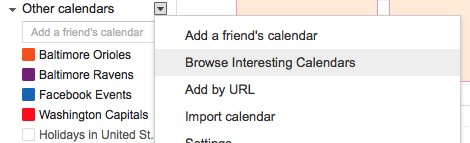
I use Google Calendar as the backend for all my calendaring needs, so I subscribed to it there, but you can use whatever calendaring app you want. Most should support it. Along with the Facebook Events Calendar, I also subscribed to calendars for my favorite sports teams. Just add them by clicking Browse Interesting Calendars. For added ambiance, I set the color of the calendar to match the team colors. (Note: these are read-only calendars. Information only syncs one way – to you. You cannot change events on these calendars.)

2016-03-31 screenshot-2

Now if you use Google Calendar, you likely already know that calendars can be toggled on or off. Kendra’s workflow consists of toggling the Facebook calendar on to check for possible things to do when she does her weekly planning. When she find’s something, she copies the event to her own calendar. If you only use Google Calendar, you’re done here.

I manage my calendars through Fantastical, which lets you make “calendar sets,” to quickly toggle multiple calendars on or off. It’s the calendar sets that makes this tip even better for me. I set up a “Sports & Events” set that toggles off all calendars except for sports, birthdays, and Facebook events all at once.

2016-03-31 screenshot-5

Like Kendra, if I’m planning or just trying to find something interesting to do, I just switch to the Sports & Events set. If something catches my eye, I can right click the event and select the “Duplicate” option to automatically add that event to my own calendar, bringing over any event info with it. Admittedly, my favorite part of this workflow is that one of my last remaining reasons to visit Facebook, finding events, is gone.

Creating A Minimal Browsing Experiencing in Safari

Years ago, back when theming a Mac was possible, it wasn’t uncommon for me to spend hours tweaking the way the menu bar looked or changing the stock icons of my favorite apps. These days I’m pretty content with the way OS X looks though, which is good since Apple’s greatly reduced the ability to customize it. In any event, I’ve always done my best to hide things that didn’t need to be seen. Case in point, this screenshot from 2008 where I meticulously picked out every icon to match the wallpaper.

I’m no where near as into customizing as I used to be, but I still try to keep things as minimal as possible. Bartender’s a great example of an app that does that by keeping my menu bar tidy. I rely heavily on Bartender’s ability to only show an item in the menu bar if it detects a change. In fact thanks to that feature, on a regular basis, I only have 3 things in my menu bar: Healthier only when I’m at my desk, Fantastical, and the time (and of course the dots are Bartender itself).

03_29_16 at 01.05.01PM

Somehow Safari ended up being the next app to be caught in my minimizing grasps and the results are a Safari interface that’s as minimal as I’ve ever had it. The minimalism isn’t just for looks though. It’s actually changed my behavior, making me more mindful of my browsing and more efficient too.

Hide Unnecessary Extensions and Buttons in the Toolbar

The first thing I did to simplify Safari was to hide any uncessary extensions and buttons on the toolbar. Only the things I truly use regularly need to be in the toolbar for quick access. For me this meant things like the Pinterest button didn’t make the cut. Pinterest unfortunately doesn’t have Share extension support where I’d prefer it to be located, but I’ll share my solution in a second. 1Password, the Share extension, and downloads are the only thing occupying the right side of my toolbar these days.

Remove the Favorites Bar

The next thing I removed was the favorites bar. This was a pretty big step for me. I’ve always had the favorites bar shown in my browsers for as long as I’ve been using a computer. I was worried I’d miss it, and I did for about 20 minutes. After those 20 minutes, my muscle memory had completely switched to using Alfred to launch my most visited sites.

Configure Alfred to Launch Bookmarklets

One thing Alfred couldn’t replicate out of the box was the bookmarklets that lived in my favorites bar. Paprika, my recipe manager of choice, allows you to import recipes from websites, but it does so using a bookmarklet rather than an extension. (Maybe one day that will change.) Without access to my favorites bar, saving a recipe became a lot more complicated than a single click. Thankfully, I found a wonderful Alfred workflow that let’s you trigger a bookmarklet with a keyword. I used “paprika” as the keyword to launch Paprika’s bookmarklet purely so I didn’t need to remember something else. Now when I’m on a site, I just need to launch Alfred and start typing paprika to get the bookmarklet.

timed-03_29_16 at 01.20.49PM

With the bookmarklet solution figured out for Paprika, I used the same workflow to make one for Pinterest. Remember I removed the button from the toolbar, so I needed a way to pin things. Pinterest’s bookmarklet, available originally for the iPhone before it got it’s own dedicated share extension, is available here.

New Windows Open Blank

Rather than launch a particular page or display my favorites, I opted to have new windows launch with a blank page. Minimal yes, but it has greatly reduced the mindless visiting of certain sites that I found myself opening purely because of habit. So here you have it folks, my Safari experience.

03_29_16 at 01.40.57PM

The Mindful Browsing Extension

03_29_16 at 01.28.58PM

My last Safari tweak is actually the addition of an extension called Mindful Browsing. If I find myself visiting a distracting site, I can click a button on the toolbar to block the site. Next time I visit it, I’ll be met with a timer (set to a time of your choosing) and a message asking me to reconsider my decision. Another handy addition is the inclusion of when you last visited the site, which serves as a great reminder for how often you actually visit distracting sites.

My Digital Detox

photo-1423666639041-f56000c27a9a.jpgThe internet is a wonderful place, but spending 40+ hours a week on it has lead me to the point of information overload. While I love consuming information, eventually it’s gotten to be too much, and I’ve had to start limiting my consumption. Much like decluttering physical clutter, reducing the constant flow of information has now become a bit of a hobby for me.
Step 1. Purge

The first thing I did was unsubscribe from things ruthlessly. If it wasn’t bringing value (or joy – Hi Marie Kondo fans) to my life, it had to go. This meant unfriending people on Facebook or at least hiding their posts, unfollowing people and companies on Twitter, and unsubcribing from subreddits and RSS feeds. I also paid careful attention to people and companies I happened to be following in more than one place.

Step 2. Eliminate Unnecessary Distraction

I removed all social media apps from my phone with the exception of Slack, which I use for work purposes, and Instagram, for sharing photos. Now I have no need to mindlessly scroll through Facebook, Twitter, or Reddit from my phone. (I’d get rid of Instagram too, but I’ve yet to find a way to post photos without the app.) If I want to check up on my accounts, I can do so on my computer and focus my time away from my computer on who I’m with and what I’m doing.

Step 3. Establish Ground Rules

Eventually I decided no amount of filtering my Facebook newsfeed would be enough to remove the negativity it was evoking. I haven’t deactivated my account as I still feel there is some merit to friends including me in events, but I have decided I won’t be checking notifications and messages regularly. My last status update pointed people to other ways they can reach or follow me that don’t involve flooding me with negativity – these are my “ground rules”:

  • If it’s important, the best way to reach me is to text me.
  • If it’s photos they want to see, there’s Instagram.
  • If it’s random tidbits of my life on the internet they enjoyed, there’s Twitter.
  • If they want to send me things to check out or see what I’m reading, there’s Pocket.
  • If all else fails, there’s email or talking to me in person.

The benefits of these rules are numerous:

  • I have fewer places to check for updates, and the places I am checking are already part of my preferred workflow.
  • The information that comes to me is more of what I actually want to see and less of what people are telling me to see.
  • I’m more mindful of what I’m doing when I’m on my phone – no mindless scrolling through content.
  • The places I’m sharing content are all public which is a great incentive to focus on sharing content that represents me as I truly want to be represented.
  • The services I continue to use all allow me to cross post to other services easily. If I want to share an Instagram photo or an article from Pocket to Twitter, I can do that easily.
  • There’s now one less service in the Share menu on my phone and computer.

Using Workflow to Launch Spotify Playlists

For as long as I’ve owned an iPhone, a music app has occupied the fourth spot on my dock and for nearly as long, that app has been Spotify. Those who saw my last post about what’s on my homescreen will notice it’s been removed from the dock. That’s because I have an even easier way to use access Spotify.

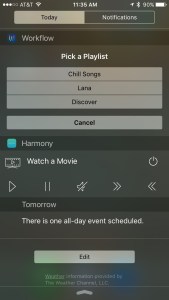
After dipping my toes in some Workflow ummm… workflows?… I started playing around with other things I could do which lead me to my Spotify workflow. Spotify lived in my dock primarily so I could have quick access to one of the few playlists I listen to while driving, but the app isn’t as intuitive as I’d like so I usually ended up fumbling around. That all changed with one simple workflow that I can access from a Today widget.

Image-1

Tapping on “Open a Playlist” gives me access to my top three playlists from anywhere on my phone simply by swiping down. Even better, it was a breeze to set up because Spotify allows you to copy the deep link directly from the app (either the Mac version or iOS version). You can modify the workflow for yourself by going the the album or playlist and clicking the three dots to access the Share menu where you’ll have the option to “Copy the Playlist Link”. Once you have the link, you’ll need to modify it a bit so that it opens the Spotify app rather than Safari. Your link should look something like this (minus the quotes):

"spotify:user:yourusername:playlist:playlistcode"

I’m toying with the idea of adding a 4th option to search Spotify entirely, but for now this has been sufficient. It’s also a heck of a lot simpler than fumbling through Spotify’s unintuitive app layout.

What’s on my home screen? (2016 Edition)

It’s been a while since I’ve posted my last home screen post, December of 2014 to be exact. I was surprised to see that many of the apps I used back then are still on my phone (14/20 are still there), which reaffirms my belief that innovation in the App Store has someone stagnated. Despite my interest in trying new apps, none seem to come close to the ones on my home screen and the top lists on sites like Homescreen.is and the App Store itself seem to point to other people agreeing as well.

IMG_5770

I’ve always viewed the home screen as a dashboard of sorts. Across the top row, you’ll find Fantastical, Dark Sky, Omnifocus, and the Fitbit app. Together these apps paint a pretty good picture of my day: where do I need to be, how’s the weather, what do I need to do, and general activity stats (sleep, heart rate, weight, etc). (I also use Fitbit for tracking how much water I drink.)

The next row is for reference: Day One for journaling, Momentum for habit tracking, Mint for finances, and Notes for capturing bits and pieces I want to remember (carryout menus and what we usually order, date ideas, restaurants to try, etc.)

My third row is for media: Reeder and Pocket for RSS and anything else I want to read or watch later, Overcast for my ever-growing podcast obsession, and Spotify, which for the first time ever has moved out of my dock. I’ll explain why in a future post. (Hint: Workflow is involved.)

The next two rows are kind of my miscellaneous frequently used utilities: Waze, Phone (although I rarely use my iPhone as a phone), 1Password, the App Store and Settings.

Last but not least, the dock, which also features an Andrea-home-screen first – only three icons: Messages, Airmail primarily for triaging mail that I later process at my Mac, and Safari.

For those of you wondering, no I didn’t clean this up for the screenshot, and no I’m not one of those people who turn off all notifications. Anything that happens to have a badge on the home screen is incredibly important though and deserving of pretty rapid attention so it doesn’t stay with a badge for long.

Using Workflow with Day One

This blog got a huge traffic boost last week after Day One shared my last post, How I’m Using Day One 2. People really liked my Review journal for capturing my thoughts on everything from food and drink to movies and books. My process is straight forward. Each entry contains a photo of what I’m reviewing (if I remembered), what it’s called, who makes it, a rating between ★-★★★★★ and a tag describing the type of item. Day One automatically adds the location and time information. The result is a collection of journal entries I can narrow results by search or filter by tags (e.g. only show me books). I can also see my reviews on both a map or calendar showing me where I’ve been and when.

My process involved some combination of Text Expander snippets and Launch Center Pro actions, and a lot of people wanted to know more. With the update to Day One 2, I started having trouble with Launch Center Pro reliably sending my text to Day One, so I went back to just using Text Expander for a while. More often than not, I just typed out the 1 line of text on my own though. I wanted something better.

Queue Workflow

Workflow is one of those apps power users seem to love talking about. However it seems like most of the talk I’ve seen centers around figuring out what in the world to actually do with it in the first place. I’m no exception. Workflow was an “insta-buy” for me when it hit the App Store mainly because I was convinced it would be taken down and wanted a chance to try it. Miraculously, Apple has allowed it to stay in the App Store and even promotes it. Try as I might though, I could never find a use for it. Periodically, I would reinstall it in hopes of a new idea, but it always ended the same way – uninstalling it from my phone – at least until my Day One post came out.

Workflow for a Gratitude Journal

I have to give a lot of credit to reader Todd, who shared a workflow for a Gratitude Journal made by Ashley Theiss in the comments of my previous post. As far as Gratitude Journals go, this is a pretty darn thorough one. I still prefer the simplicity of capturing 3 things I’m grateful for each night. (Day One shows all three things in every entry without having to open up the entry allowing me to see everything I’m grateful for right away.)

I may have passed on using the workflow, but what was useful was seeing how it worked. Anyone who’s ever learned to code, knows that a big part of it is looking at code that’s already written and learning how it works. Understanding Workflow is a lot like that. Seeing how it worked, I was quickly able to modify the workflow to make a template for my own Gratitude Journal, and now I can launch it from my Today screen each night. You can find it here.

Workflow for Reviews

Tweaking the Gratitude Journal template got my wheels spinning, and I started thinking I could use it for my food and drink templates for my Review Journal. How hard could it be, right? Surprisingly, not too hard at all. After a bit of trial and error, I ended up with a Workflow that replicated my beer template, asked me to take a picture, and passed it all along to Day One tagged correctly.

Once I had the basics down, I just copied the Workflow and changed the wording a bit until I had one that worked for food. It wasn’t long before my Today screen started growing out of control though. By the end of it I had 4 separate Workflows just to add various types of food and drink.

Being a minimalist, I want my Today screen as simple as possible. Each of my workflows was fairly similar, and I’d already figured out the Menu action, so I took it a step further, and added one more menu. The result is the workflow you’ll see below – a single “Log Food or Drink” workflow fully capable of setting the tag based on what you want to log. I’m really happy with the results. You can find the full workflow here.

LogFoodorDrinkWorkflow

How I’m Using Day One 2

I purchased Day One for both iOS and Mac years ago, but, admittedly, using it as a journal never really clicked no matter how hard I tried. I spent a lot of time perusing Day One’s Uses section, until at some point, I stumbled upon Giftttdy and decided I would use Day One as a lifelog. Fast forward a few months, and Day One had quickly turned into a jumbled mess of duplicated posts due to crossposting to various platforms and a long list of tags that made me cringe whenever I opened it. Don’t get me wrong, Giftttdy is a great idea. It just didn’t work out for me, and I eventually painstakingly deleted every auto-logged entry one by one. If only I had waited until Day One 2, which added the ability to edit multiple entries, came out, I could have saved myself a lot of time.

Nevertheless, it’s been about a month since Day One 2 was released, and despite my past troubles with journaling, both the Mac and iOS versions were “insta-buys” and also “insta-recommends”. Much to my surprise, the added features were exactly what I needed to fuel a new journaling habit. I was instantly trying to find new things to journal. Sadly, despite my countless searches, I’ve yet to find many people discussing how they’ve decided to take advantage of Day One 2’s features. I have, however, found quite a few people looking for exactly that that have also come up empty handed –> queue the rationale behind post.

Day One 2 now supports multiple journals (up to 10), and this may be the single most behavior-changing feature for me. As I mentioned before, I hated opening Day One to a jumbled mess. I had plenty of things I wanted to capture, but everything was lumped together. With Day One 2, thats no longer the case.

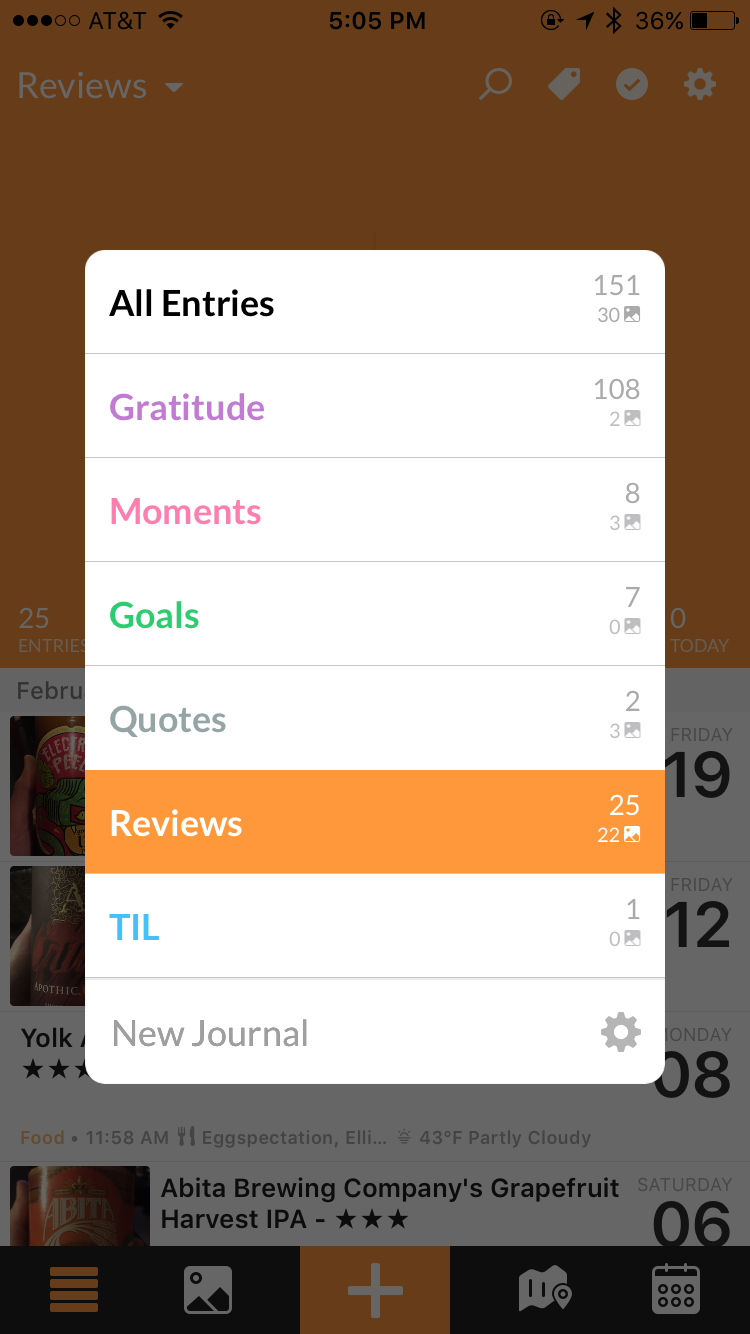
So without further ado, here is how I’m using Day One 2. I currently have 6 journals:

Journal list

  • Gratitude for logging 3 things I’m grateful for each night. This habit is something I continue to see recommended time and time again, and having done it off and on for a few years now, I can attest to its benefits. I don’t regularly review my entries, but on days I happen to see one, it’s nice to look back at what made me happy that day. I use a super simple Text Expander snippet for this that just puts “I’m grateful for…” followed by 3 bullets.
  • My second journal, Moments, is for recording any special moments I’d like to remember later. I tag them accordingly based on what type of moment they might be: conversations, dreams, something I feel the need to vent about. This journal gives me an outlet for my thoughts other than my boyfriend or best friend who I’m sure both appreciate the decrease in the number of rants I share.
  • I also have a Goals journal where I store my yearly list of goals I’d like to work towards. I used to keep text files for each year, but it’s nice to be able to look back at them in one place whenever I want.
  • Quotes is for, well, quotes. I’d always been envious of those people who kept a list of quotes. While I’ve highlighted or saved some over the years, I never really settled on a single place to keep them, so the majority disappeared, never to be seen again. Now whether I snap a picture of a quote I come across in a hardback book or copy and paste one I find digitally, they all can live in one place.
  • Reviews is probably my most favorite journal. Despite the picture below making it seem like I only eat at DuClaw, my boyfriend and I actually do enjoy trying new places to eat and drink, and this journal gives me a place to record what I love and, occasionally, what doesn’t love me back so that I know never to order it again. I also use it for books, movies, and music. It’s turned into my own personal combination of Yelp, Untappd, Goodreads, and Rotten Tomatoes. Plus it’s downright nice to look at. It takes 5 seconds to grab a photo and use Text Expander snippets to log what and by whom or where, along with a 1-5 star rating. Day One also tracks location and time so I can quickly see a map of where I’ve eaten and the calendar view provides a nice overview of when. I also tag these by type which allows me to filter the list based on type, location, date, or name.

Review List

  • My last journal is entitled TIL, “Today I Learned”. It’s the newest journal and came from a recommendation on Lifehacker which happened to feature Day One in the screenshot. I haven’t been noting something I learned each day like the recommendation, but it will be helpful for capturing tidbits of information that would be helpful to retain that don’t necessarily have a place to be stored (e.g. where to send that random support request that only comes in once every 2 years).

Tags haven’t really changed in Day One, but paired with multiple journals, they’ve become much more useful because they can be applied across journals. The minute this occurred to me, I was flooded with inspiration. Filtering by the tag “Book” pulls up entries for book quotes in the Quotes journal and book reviews in Reviews. Similarly, a search for the tag “work” might pull up entries in my Moments journal or TIL.

So that’s how I’m using Day One.

Update: See my latest post on how I’m using Workflow to automate logging food and drinks to my Review Journal