First of all, wow it’s been a long time. Sorry for not posting since May. I feel like I blinked and now we’re already more than halfway through 2021. Full disclosure though, I also haven’t had a lot of inspiration to write either. Posts that seem to do well on here are typically related to Things 3 or note taking, and quite frankly, my system doesn’t really change all that much to have new things to write about.
When I found Getting Things Done (GTD) in high school, it was life changing. The methodology just clicked and I never looked back. Whether I was using Things 2, a Filofax, Omnifocus, or now, Things 3, GTD has always been the backbone of how I manage life.
My concept of GTD has changed significantly over the years. GTD is one of the few books I reread every few years. Each time I read it the book seems to hit differently and I grasp the concepts a little more. Every so often I also find myself having small breakthroughs where a concept clicks just a little more. While the breakthroughs seem to be fewer and far between these days, I do have occasional moments where I still find my GTD practice changing.
In the past, examples have included fully understanding what capturing everything actually entails (It’s more than you think!), why something that takes more than one step really should be a project and not a single action, and why it actually can be sufficient to only have a single next action in a project rather than planning every detail out at the start.
My most recent breakthrough is understanding mind like water.
For much of the past year and a half, I’ve run myself ragged, stressing about all the projects I was responsible for, many of which I had never encountered like managing a remote team, setting up a socially distanced office, planning a return to the office when the conditions seem to be shifting daily (go get vaccinated folks!), or dealing with a sick pet.
In every one of these cases, most of the stress was due to simply not knowing what to do next, and as more and more of these piled up, the overwhelm set in hard.
In a recent chat with my therapist, we discussed how one of my coping mechanisms for stress is creating systems and solving problems. Sadly I usually do this out of desperation rather than regular practice. Rather than feeling helpless in a situation, her suggestion was to shift my thinking and problem solve at least one thing I could do to make me feel more at ease – to make a stressful situation a little less scary.
In writing this, I find myself realizing this probably sounds a lot like next actions, but I actually think about it a little differently.
For next actions, I ask myself the question, “What is the next thing that needs to get done to move this project forward?” This question is all about progress and completion.
For mind like water, I’m asking myself, “What is something I could do to feel more at ease?” Here I’m more concerned about what’s going to make me feel better.
In some cases, the answers to these questions might even be the same. In my sick pet example, the next action was to clearly call the vet to schedule an appointment. However, I found myself stalling because I hate making phone calls, how busy my vet is, how much my pet hates going to the vet, and how scary the diagnosis could be. All of these things were overwhelming, but what was more overwhelming? Knowing my pet was sick, not knowing why, constantly telling myself I should be calling to schedule an appointment, and beating myself up for not doing it because I’m a responsible pet owner. Without question, the thing to put me more at ease was to just make the call.
It’s a small mindset shift, but in cases where I’m truly feeling stressed, it’s that small shift that takes me from feeling like things are out of control and helpless to seeing a path through.
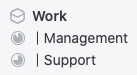
 In recent weeks, I’ve developed a new appreciation for
  Unless Things 3 decides to add headers to areas, you’re stuck with using projects or tags to denote your sub areas of responsibility. I’ve opted to use projects because I like seeing the visual reminder of what I’m responsible for. This, unfortunately, leaves me with no distinction between my projects and sub areas. Admittedly, this was an issue with Omnifocus as well, so I’ve gotten into the habit of prefixing projects with a checkbox symbol to differentiate them from sub areas. It’s not perfect, but it works.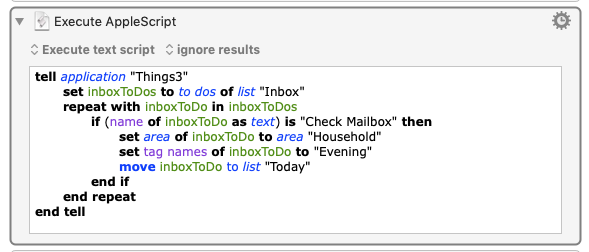

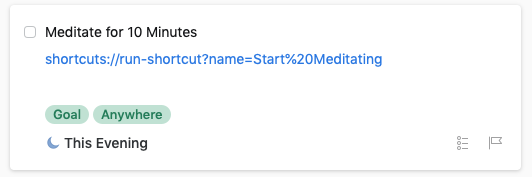

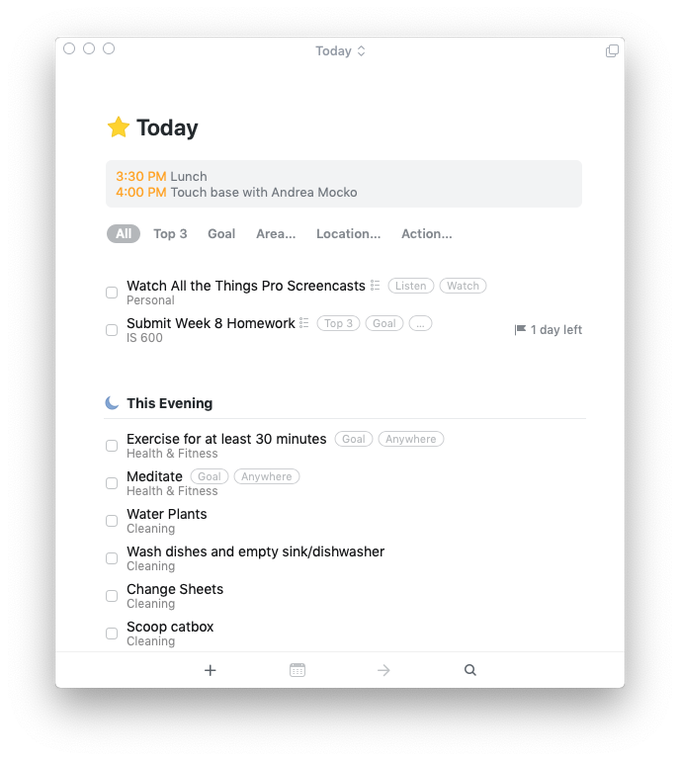
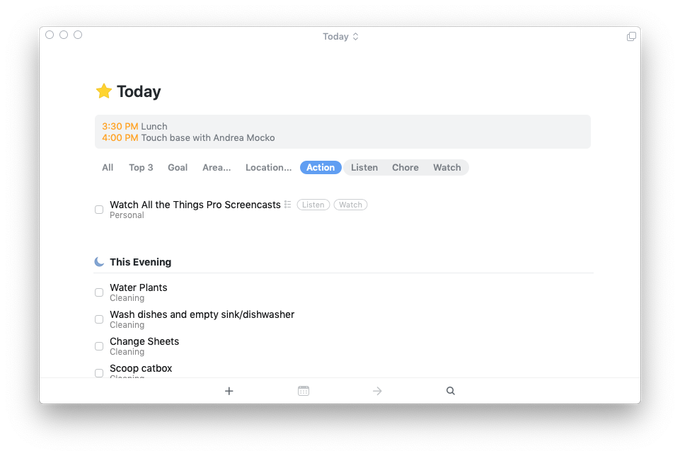 I use tags to filter my Today view down at various times of the day. For instance, I can easily filter my list to my Top 3 tasks for a quick priority check, or I can use tags to batch my tasks.

 Multiple tags first came to
  According to Andrea